



Welcome to gochengdu.cn!
You need to accept our privacy and cookie policy to continue to browse our website. You can change your cookie settings through your browser.

Earning points through greenway cycling, cool shelters in communities bringing relief, and rural woodlands generating carbon sinks... As these small green deeds close to ordinary people converge into systematic urban governance solutions, Chengdu's park city development practices have stepped into the international spotlight at the 31st Conference of the Parties to the United Nations Framework Convention on Climate Change (COP31).
As one of the side events of COP31, the themed side event "Inclusive Green Business in Emerging Markets: Advancing Private Sector Action for a Just Climate Transition" was held on November 14 local time at the EXPO Center in Antalya, Türkiye, focusing on how to promote corporate participation in climate action and enable the green transition to benefit more groups.
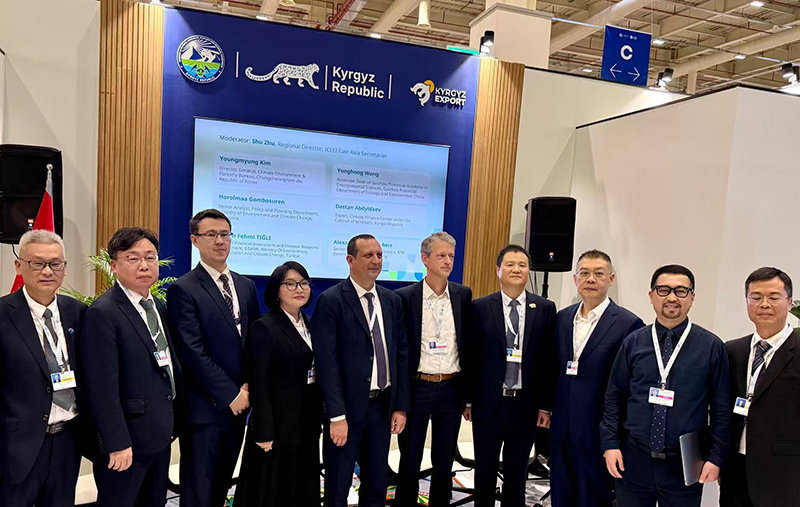
Attending the 31st Conference of the Parties to the United Nations Framework Convention on Climate Change (COP31), and participating in a series of closed-door seminars and special discussions organized by ICLEI on local government climate action, climate finance and green finance, and “zero-waste cities”
Chengdu's "Carbon-Benefit Tianfu" initiative and its megacity climate adaptation practices were showcased at the relevant side events, presenting Chengdu's green and low-carbon achievements. Against this backdrop, Chengdu is actively expanding international cooperation in the field of urban sustainable development.
Leveraging the International Conference Platform to Deepen External Cooperation in the Climate Field
Starting from the Antalya venue, Chengdu brought its carbon inclusion practices to the international community. At the themed side event "Inclusive Green Business in Emerging Markets: Advancing Private Sector Action for a Just Climate Transition," the 2026 White Paper on Carbon Inclusion Development (hereinafter referred to as the White Paper) was officially released. Li Wei, a representative of Chengdu's "Carbon-Benefit Tianfu" green public welfare platform and director of the Chengdu Academy of Environmental Sciences, introduced Chengdu's carbon inclusion practices and shared how ordinary citizens, small and micro enterprises, communities, and rural areas can participate in emission reduction and share the benefits.
"Climate action has never been the task of a few." Li Wei said that "Carbon-Benefit Tianfu" incorporates everyday low-carbon behaviors and emission reduction actions in production and operation into its "dual-path" incentive mechanism for the public and market entities, providing a supplementary channel for scattered emission reduction, small and micro entities, and public participation not yet covered by the mandatory carbon market.
The newly released White Paper systematically reviews the global progress, methodological framework, and business models of carbon inclusion, compiles practical cases from Chengdu and other places at home and abroad, and shares experience in digital platform development, private sector collaboration, and the transformation of urban-rural ecological value, providing reference for more cities to carry out related explorations.
At the COP31 China Pavilion's side event on the global sustainable development city dialogue, Xiao Ying, a member of the Party Leadership Group and deputy director of the Chengdu Municipal Bureau of Ecology and Environment, made remarks on Chengdu's climate adaptation actions. Facing climate risks such as heat waves, rainstorms, and floods, Chengdu has integrated the concept of climate adaptation into urban planning, construction, and governance, deployed and implemented ten special actions, systematically advanced the construction of a climate-adaptive city, and explored specific approaches for megacities to enhance climate resilience.
In addition, during the conference, the Chengdu Municipal Bureau of Ecology and Environment signed a strategic cooperation memorandum of understanding with the ICLEI Urban Sustainable Development Promotion Center in the Chengdu Hi-tech Zone, to carry out cooperation in areas such as park city and ecological civilization development, resilient cities and climate action, and green industry and low-carbon transition.
Relying on ICLEI's global network, the two sides will promote exchanges between Chengdu and relevant cities, international organizations, and professional institutions, facilitate alignment among governments, enterprises, research institutions, and international partners, explore technical cooperation and demonstration projects, support green industries and technologies going global, and share Chengdu's practices through channels such as international conferences and special training.
Carbon Inclusion Takes Root, with Everyone Participating in Low-carbon Emission Reduction
In Chengdu, a green trip is not just about taking one less car ride — it can also accumulate carbon points, which can be redeemed for benefits or donated to support public welfare projects. Along such everyday tracks, climate action is becoming part of more and more people's daily lives.
At present, the "Carbon-Benefit Tianfu" platform has attracted 4.2 million registered users. The platform converts low-carbon behaviors such as green travel, greenway cycling, waste sorting, and ecological volunteer services into carbon points, which citizens can redeem for benefits such as bus and metro rides, scenic spot tickets, and green products, or donate to participate in ecological restoration. In line with park city living scenarios, the platform has also incorporated volunteer activities such as ecological science popularization and giant panda protection, combining low-carbon action with local culture and community public welfare.
For small, medium and micro enterprises, Chengdu has focused on tackling the difficulties in accounting for scattered emission reduction actions and their high participation costs, developing three categories of localized carbon emission reduction methodologies — resource conservation, energy substitution, and ecological protection — and supporting eligible small and micro enterprises, cooperatives, and rural collectives in developing carbon inclusion emission reductions. From institutional design and methodology development to project certification and emission reduction consumption, Chengdu has steadily improved its operational system and supported large-scale events such as the World University Games in carrying out carbon neutrality practices.
Strengthening Urban Climate Resilience So Citizens can Feel the Tangible Benefits of Climate Change Adaptation
Parks, greenways, rivers, lakes, and wetlands are not only places for citizens to relax but also ecological spaces for the city to cope with climate risks. Chengdu has integrated sponge systems into its park city blue-green network. By the end of 2025, it had built more than 1,500 parks of various types and over 10,000 kilometers of Tianfu Greenway, with 50.71% of the urban built-up area meeting sponge city requirements. Among them, the Chengdu Ring Ecological Zone, relying on 133 square kilometers of ecological land and a 100-kilometer ring greenway, connects six lakes and eight wetlands, playing a role in ventilation and hydrological regulation.
In response to the basin's "stuffy, hot, and still" climate characteristics, Chengdu has scientifically established an "8+N" two-tier ventilation corridor system, incorporated it into the territorial spatial master plan, and formulated special control rules to ensure airflow channels and mitigate the heat island effect in the central urban area. At the same time, it has built a "1+2+N" city-level virtual power plant system with an adjustable capacity of 1 million kilowatts, enhancing energy security through precise peak shaving.
The results of climate adaptation are also reflected in perceptible everyday scenes. The Pastoral School in Gaopo Village, Pingwu Town, Jianyang City uses technologies such as self-insulating double-layer hollow walls, natural ventilation, and west-facing shading to achieve comfortable operation of rural public buildings without air conditioning; the Wanshouqiao community, relying on Qingshuihe Park, has added shading facilities, optimized walking routes, and improved rest spots to advance the construction of a "cool community"; 489 metro stations across the entire network, 2,425 trade union service stations, and some commercial districts, parks, and cultural venues have set up cooling areas, providing free cool spaces for citizens and outdoor workers.
From carbon points earned through cycling to cooling spots on the streets where people can rest, Chengdu is putting green, low-carbon development and climate adaptation into urban operations and citizens' lives. Through its debut at COP31, Chengdu has expressed its willingness to deepen international cooperation, looking forward to exchanges with cities, institutions, and enterprises from various countries in areas such as carbon inclusion, green supply chains, and climate resilience, and to jointly exploring transition paths that balance development and emission reduction, efficiency and equity.
Edited by Zhang Yuanlin
Source: CRI Online

