




Welcome to gochengdu.cn!
You need to accept our privacy and cookie policy to continue to browse our website. You can change your cookie settings through your browser.


The Global Panda Partners Conference 2026 is launched in Chengdu, southwest China's Sichuan Province, Nov. 3, 2026. (Xinhua/Xu Bingjie)
The main forum of the Global Panda Partners Conference 2026 opened on Tuesday in southwest China's Sichuan Province, known as the "hometown of giant pandas," drawing experts and scholars from over 30 countries and regions.
Under the theme of protecting giant panda habitats, building a beautiful world and sharing open opportunities, the event, being held in Chengdu, the provincial capital, has gathered global guests to discuss biodiversity conservation and green development cooperation.
The main forum also saw the release of a think tank report centered on China's green development path.
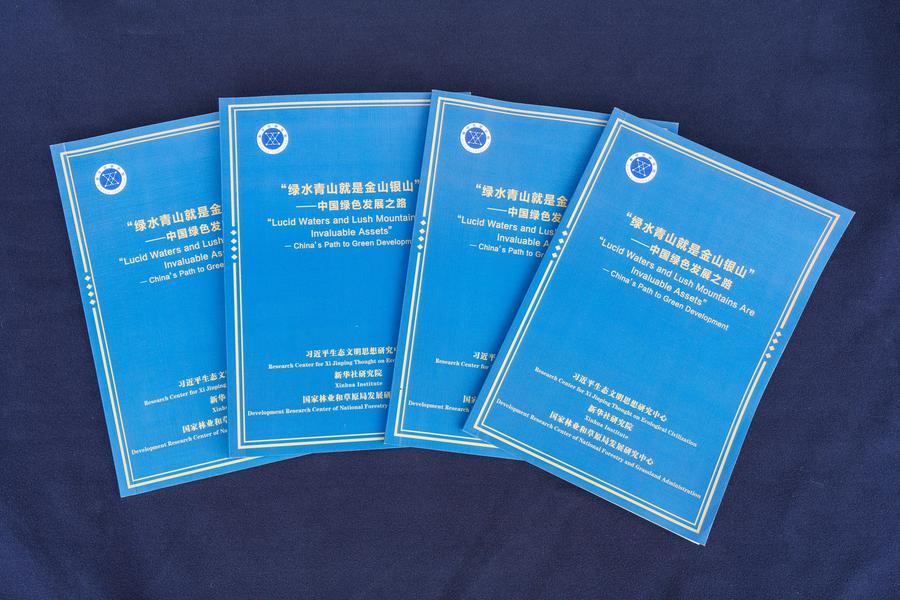
This photo shows copies of a report centered on China's green development path, which is released during the main forum of the Global Panda Partners Conference 2026 in Chengdu, southwest China's Sichuan Province. (Xinhua/Wang Xi)
Lyu Yansong, editor-in-chief of Xinhua News Agency, said giant pandas are China's national treasure and a shared wealth of all humanity. He noted that the Global Panda Partners Conference is striving to become an important bond for gathering global wisdom and jointly protecting the planet, while continuously expanding the circle of friends of "panda partners."
According to Li Yunqing, deputy head of the National Forestry and Grassland Administration, the captive population of giant pandas in China has reached 830, while the genetic diversity of the population continues to improve.

Guests pose for a selfie with a robot at a fair during the Global Panda Partners Conference 2026 in Chengdu, southwest China's Sichuan Province, Nov. 3, 2026. (Xinhua/Xu Bingjie)
Noting that this year marks the 30th anniversary of international scientific research cooperation on giant pandas, the official said that China has cooperated with 26 institutions in 20 countries, resulting in 69 giant pandas living overseas and 73 cubs successfully bred, while the species has drawn over 1 billion visits worldwide.
Shahbaz Khan, director of the UNESCO Regional Office for East Asia, said the giant panda inspires affection across languages and generations, and protecting this remarkable animal means caring for the living systems that sustain many other species and support human well-being.
China's establishment of the Giant Panda National Park in 2021 has provided an important framework for conservation across the provinces of Sichuan, Shaanxi and Gansu. Work to restore habitats, reconnect ecological corridors and strengthen coordinated management offers valuable experience in protecting ecosystems across administrative boundaries, he noted.
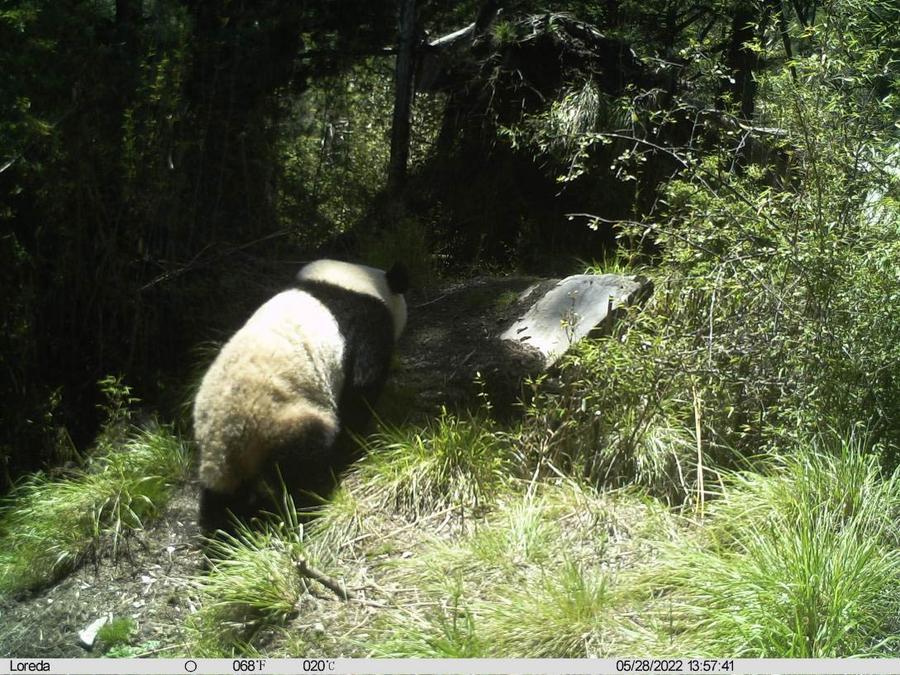
This photo taken by an infrared camera on May 28, 2022 shows a wild giant panda at the Tangjiahe Nature Reserve of the Giant Panda National Park in southwest China's Sichuan Province. (Tangjiahe Nature Reserve of the Giant Panda National Park/Handout via Xinhua)
"UNESCO looks forward to continued dialogue with Chinese and international partners on safeguarding natural heritage," the director said.
Running from Monday to Wednesday, the conference features a main forum, multiple parallel sessions, and other supporting activities centered on international cooperation in giant panda conservation, cultural tourism and other topics.
This marks the third edition of the conference. The inaugural conference was held in November 2024 in Chengdu with the theme "Harmonious Coexistence Between Man and Nature."
This year's event is co-hosted by the Brand Work Office of Xinhua News Agency, the agency's Sichuan branch, its news and information center, China Wildlife Conservation Association, China Conservation and Research Center for the Giant Panda, and Chengdu Media Group.
Sichuan has the largest panda habitat in the world and is home to over 70 percent of China's wild giant panda population.
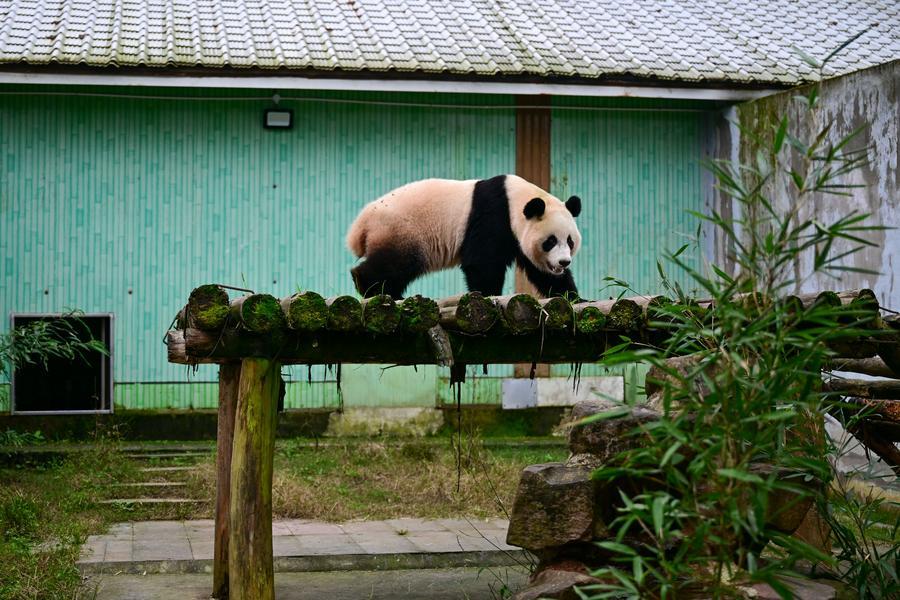
Giant panda Lang Yue, which just returned to China from a zoo in the Netherlands, is pictured at an isolation and quarantine enclosure at the Ya'an base of China Conservation and Research Center for the Giant Panda in Ya'an City, southwest China's Sichuan Province, Oct. 31, 2026. (China Conservation and Research Center for the Giant Panda/Handout via Xinhua)
Giant panda conservation serves as a microcosm of China's endeavors to advance ecological civilization. Thanks to sustained conservation efforts, the International Union for Conservation of Nature in 2016 downgraded the giant panda's status from endangered to vulnerable.
Edited by Zhang Yuanlin
Source: Xinhua

