




Welcome to gochengdu.cn!
You need to accept our privacy and cookie policy to continue to browse our website. You can change your cookie settings through your browser.

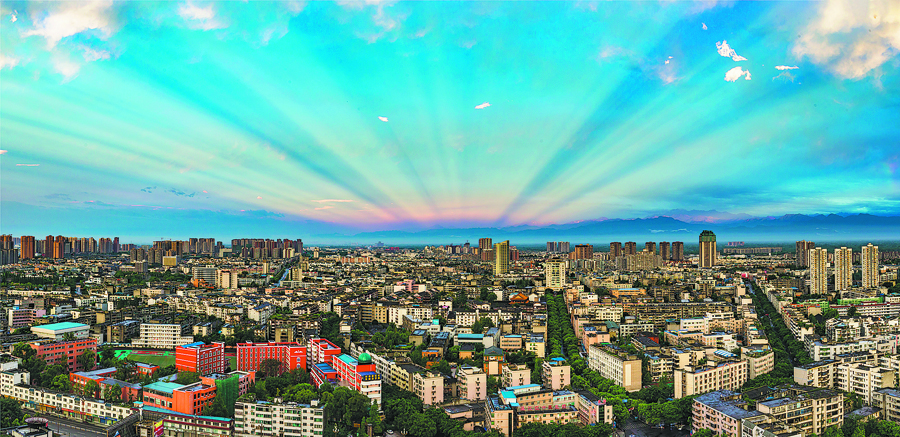
Panoramic views of the cityscape of Chengdu, Sichuan province, feature snowy mountain ranges as the backdrop. [Photo by Jia Nan and Tian Xianghe]
When photography enthusiast Jia Nan first heard his wife, a native of Chengdu in Sichuan province, recall seeing snowcapped mountains from the city as a child, he found it hard to believe.
He had just returned from a photography trip hundreds of kilometers away in the Western Sichuan Plateau, worn out by altitude sickness.
"I had never imagined that in a megacity, you could actually see snow-capped mountains without leaving the city," he says.
Jia Nan, 55, whose real name is Xie Xiaoming, moved to Chengdu in 2013 after spending years working in Shenzhen, Guangdong province.
Born in Jiangxi province, he had never seen a snow-covered mountain before. The towering peaks of western Sichuan immediately captivated him, and his fascination became an obsession. At one point, he made four or five trips to the region every month.
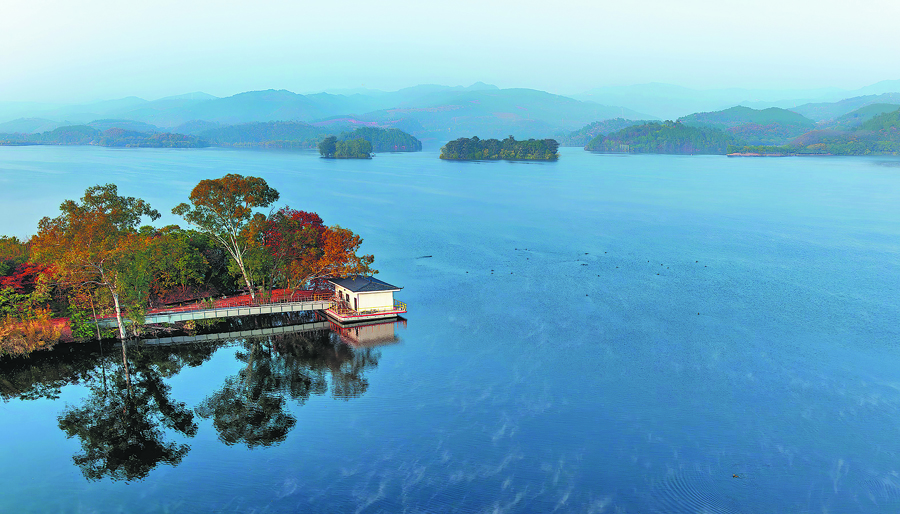
The scenic Sancha Lake in Chengdu. [Photo by Jia Nan and Tian Xianghe]
"Every time I went, the altitude sickness made me dizzy and nauseous," Jia Nan says. "Twice, it became so severe that my companions had to rush me to the emergency room."
Taking his wife's advice, he began exploring Longquan Mountain near their home in eastern Chengdu on clear days, searching for vantage points from which to photograph the distant peaks to the west. Local farmers told him the mountains occasionally emerged on the horizon.
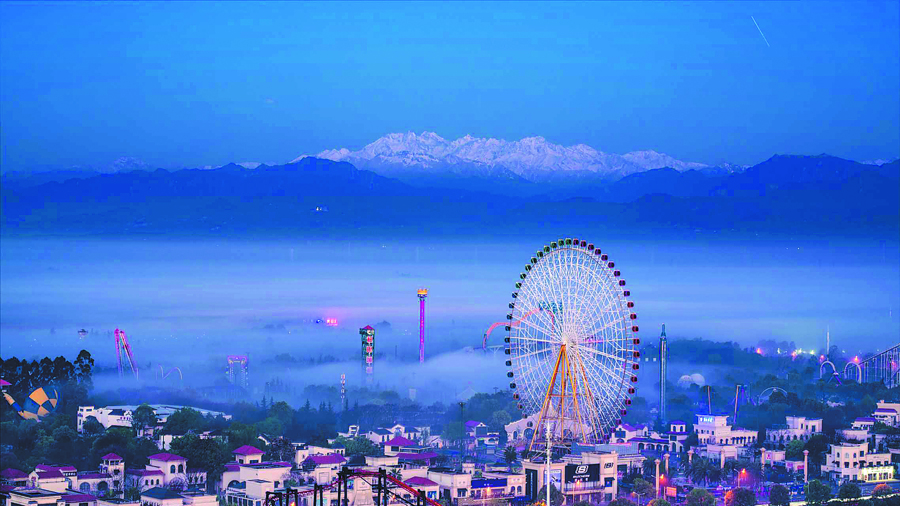
Panoramic views of the cityscape of Chengdu, Sichuan province, feature snowy mountain ranges as the backdrop. [Photo by Jia Nan and Tian Xianghe]
In August 2015, Jia Nan captured his first photograph of the snow-capped peaks from within the city. Since then, he has rarely passed up an opportunity to photograph them.
"From April to September, the best season, I don't leave Chengdu," he says.
"Even when I visit my hometown in Jiangxi, I check Chengdu's weather forecast every day so that I don't miss a clear day."
Chasing snow-clad peaks
Jia Nan's most unforgettable experience came on a June morning in 2017. Around 6 am, he set up his camera on the roof of a farmhouse on Longquan Mountain, overlooking a city still asleep in the darkness. "As the sun rose, the light turned the distant peaks red one after another from right to left, like a string of lights switching on. Then the glow swept over the city, illuminating it all," he recalls.
"Standing alone there, I got goosebumps, and my hands began to tremble."
Back home, he stitched 32 consecutive shots into a panoramic image and shared it in an online photography group, causing quite a stir.
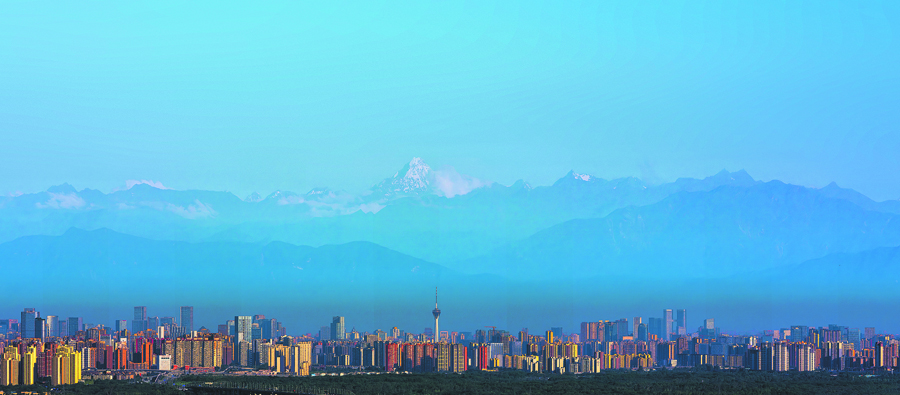
Distant snowy peaks share the skyline with the high-rises of Chengdu, a breathtaking sight on clear days. [Photo by Jia Nan and Tian Xianghe]
Titled Snow Mountain Scroll, it captures 94 high-altitude peaks rising behind Chengdu's skyline, including Mount Gongga, at over 7,500 meters above sea level, known as the "King of Sichuan Mountains" and the province's highest peak.
"Many people, including veteran local photographers, questioned it. They thought it was a mirage or a fake," Jia Nan says.
"After all, the straight-line distance from downtown Chengdu to Mount Gongga is a staggering 240 kilometers."
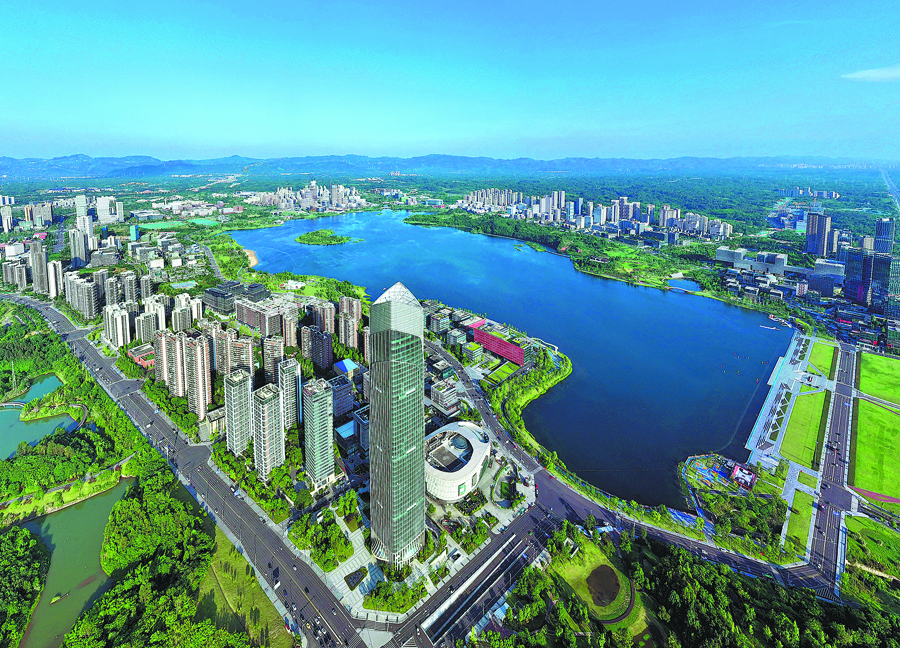
Aerial views of Xinglong Lake (left) and Tazishan Park (right) in Chengdu. [Photo by Jia Nan and Tian Xianghe]
Geography experts in the group later labeled each peak in the image, confirming it was real. The photo went viral, making Jia Nan famous in Chengdu's snow mountain photography community.
Compared with photographing the mountains from their foothills in western Sichuan, Jia Nan finds capturing them from Chengdu even more magical.
"In western Sichuan, you only capture the local peaks. But in Chengdu, you can capture an entire continuous range," he says.
"Plus, having a megacity of over 20 million people sharing the frame with snowcapped mountains is far more breathtaking than the mountains alone."
Over the years, Jia Nan has noticed a distinct change: the snow-capped peaks are appearing more frequently. In recent years, he has photographed them more than 60 times a year, compared with about 40 sightings annually in the past.
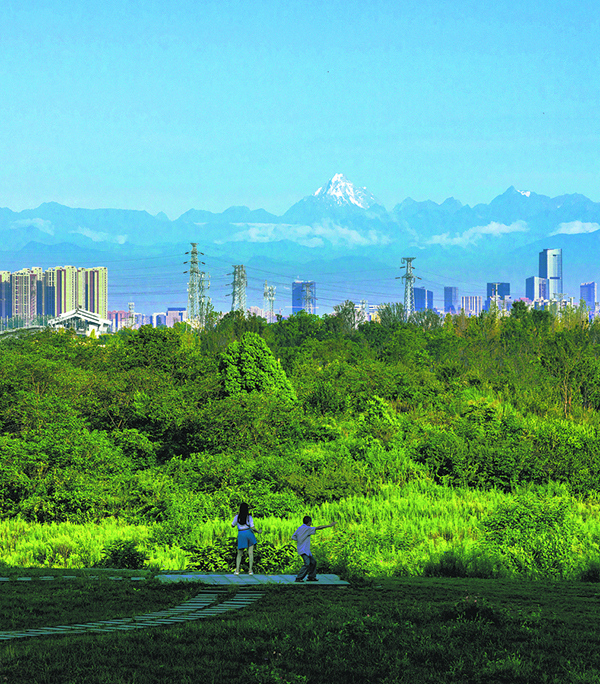
Locals work out at a park in Chengdu. [Photo by Jia Nan and Tian Xianghe]
He attributes this increase to Chengdu's implementation of the "park city" concept, which has driven sustained improvements in the city's ecology and air quality.
Official figures show that Chengdu now has more than 1,500 parks and a greenway network spanning over 10,000 kilometers, connecting parks, wetlands, forests, and other green spaces into an integrated ecological network.
The numbers confirm
Tian Xianghe, 63, who lives in Wenjiang district in western Chengdu, began photographing the mountains years before Jia Nan.
His pursuit began by chance in 2008, when a snow-capped peak suddenly emerged through the clouds as he was photographing the cityscape. After consulting maps, he identified it as Mount Siguniang, more than 100 kilometers away.
"My eyes lit up. It was unbelievable," he says.
Capturing the peaks is a race against the weather. Tian checks weather apps in advance to gauge whether the following day will bring clear skies. He then prepares his equipment, charging batteries, readying memory cards, and setting alarms. An hour before dawn, he is already at his chosen vantage point, waiting.
But the effort does not always pay off. Wind, clouds and humidity — any one of them can spoil the shot. Tian has braved his share of wind and rain, but he doesn't consider the effort wasted.
"Capturing the place where I live alongside such beautiful mountains gives me a great sense of accomplishment," he says.
Like Jia Nan, Tian has noticed that the mountains are becoming visible more often.
"In summer, seeing them has become almost routine," he says.
"Even without professional gear, people can capture the peaks with their smartphones."
Zhang Wei, a 43-year-old chip engineer and amateur photographer, used systematic data to document the trend Jia Nan and Tian observed.
Since 2017, he has recorded sightings of the distant peaks and published an annual report on Jan 1. His findings show that the mountains were initially visible from Chengdu's central urban area on about 50 days a year. That figure rose to 81 days last year, the highest on record.
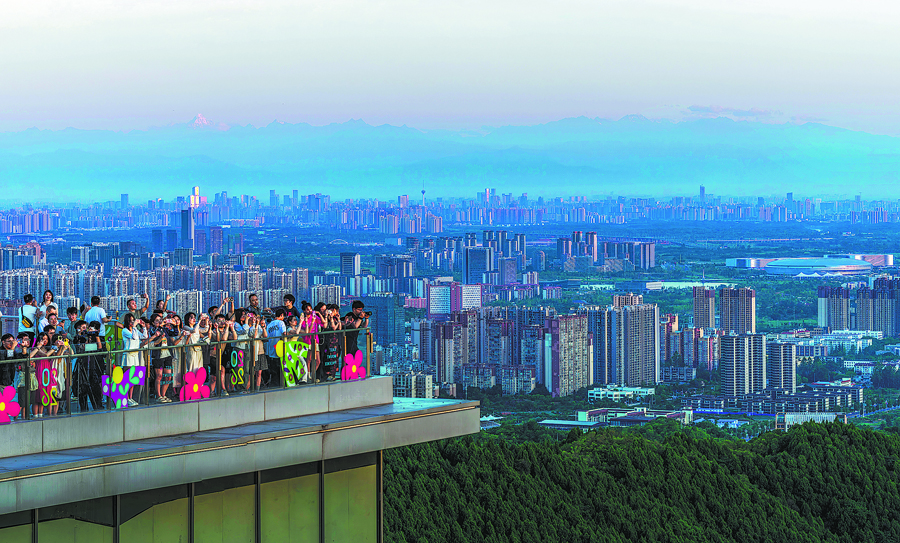
Panoramic views of the cityscape of Chengdu, Sichuan province, feature snowy mountain ranges as the backdrop. [Photo by Jia Nan and Tian Xianghe]
"We grew up reciting the famous line by poet Du Fu (712-770), 'My window frames the eternal snow of the western ridge', but few people realized that the scene he described was real," Zhang says.
"Even when photographs were shared, some meteorological experts thought they were fake."
The situation began to change in 2016. He recalls that on June 5 that year, a local photographer captured Mount Gongga. A month later, Chengdu witnessed a rare scene: snow-capped peaks framed against a sunset glow, visible from many parts of the city. Photos of the scene flooded local residents' social media feeds.
In the years that followed, a growing number of enthusiasts, social media sharing and mainstream media coverage turned mountain viewing in Chengdu from a niche hobby into a unique enjoyment for locals, Zhang says.
In 2016, he joined an online community called "Viewing Snow Mountains in Chengdu", which had been established four years earlier. "Back then, it had only a few dozen members. Today, it has about 5,000 members," he says, estimating that the city has at least 50,000 long-term mountain-viewing enthusiasts.
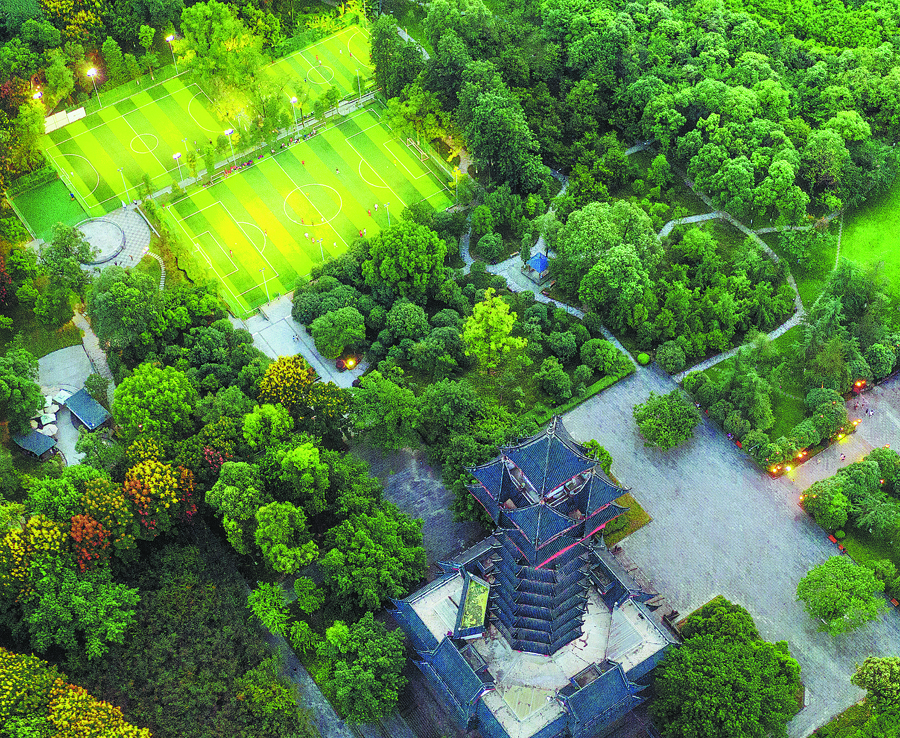
Aerial views of Xinglong Lake (left) and Tazishan Park (right) in Chengdu. [Photo by Jia Nan and Tian Xianghe]
Beyond the mountains, Jia Nan enjoys photographing Chengdu's old buildings, parks, teahouses, small eateries, flea markets, and its people.
"The city's unique culture and vibrant street life offer photographers so much to capture," he says.
Years of living here have also made him fall deeply in love with this inclusive city.
"Chengdu has given me what I wanted most in life — the chance to pursue my passion," Jia Nan says. The former fashion designer has since reinvented himself as a freelance photographer.
"For me, one of the greatest joys is taking a good photo, sharing it, and helping more people discover the beauty of this city," he adds.
Edited by Zhang Yuanlin
Source: China Daily

